

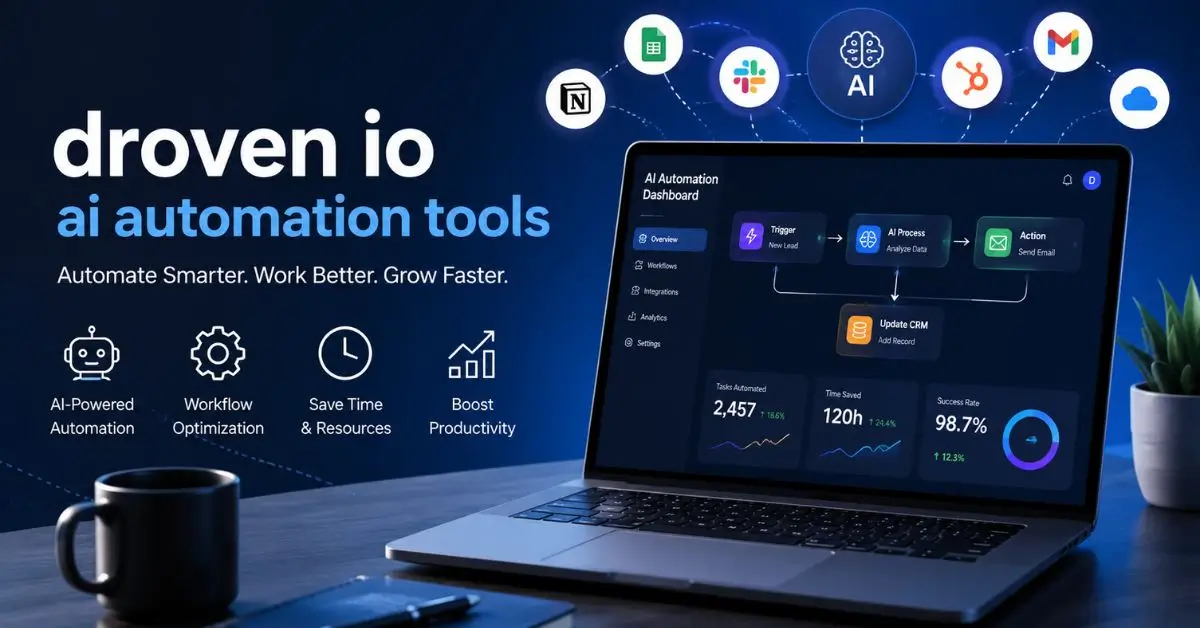
Droven io AI Automation Tools: What They Do and How to Use Them
Automation has been promised to businesses for decades. The reality has often fallen short. Traditional automation tools required significant technical expertise to set up, produced brittle workflows that broke whenever anything changed, and needed constant maintenance that consumed the time they were supposed to save.
AI-powered automation is genuinely different in ways that matter. It handles variability, learns from patterns, and adapts to changing inputs in ways that rule-based automation simply cannot. That difference is why businesses across every sector are actively evaluating AI automation platforms right now, and why understanding what specific platforms like Drovenio actually offer is more important than ever.
If you have come across droven io ai automation tools and want a clear, honest explanation of what they are, what they actually do, how they compare to other automation approaches, and whether they are right for your specific situation, this guide covers all of that directly and practically.
Droven io AI automation tools refer to the artificial intelligence-powered automation capabilities offered through the Drovenio platform, designed to help businesses and professionals streamline repetitive processes, reduce manual workload, improve decision-making through data analysis, and scale operations without proportional increases in human effort. The platform sits within the broader AI automation space, applying machine learning and intelligent process automation to real business workflows.
Quick Summary
Drovenio offers AI automation tools that help businesses reduce manual work, improve process consistency, and scale operations more efficiently. This guide explains what those tools do, which use cases they serve best, and what to consider before adopting any AI automation platform.
Why AI Automation Is Different From Traditional Automation
Before getting into what droven io ai automation tools specifically offer, understanding why AI-powered automation represents a genuine step change from earlier automation approaches helps you evaluate any platform in this space more clearly.
Traditional rule-based automation is essentially an if-then system at scale. If a specific input occurs, perform a specific defined action. This works reliably for perfectly consistent, repetitive processes but fails immediately when real-world variability enters the picture. An email that arrives in a slightly different format breaks the workflow. A document with an unusual layout defeats the data extraction process. An exception that was not anticipated when the rules were written stops the entire system.
AI automation handles variability because it works from learned patterns rather than explicit rules. A machine learning model trained on thousands of examples of invoices can extract data from a new invoice it has never seen before, even if the format is different from anything in its training data, because it understands the pattern of what invoice data looks like rather than matching a specific template.
This adaptability is what makes AI automation genuinely valuable for real business processes rather than only for perfectly consistent, exception-free workflows that rarely exist outside of highly controlled environments.
The droven io ai automation tools approach applies this capability across multiple business process categories, which is what makes the platform relevant to a diverse range of organizations and use cases.
Core AI Automation Tool Categories Drovenio Addresses
Understanding the main categories of automation that Drovenio’s tools address helps you identify whether the platform’s specific capabilities align with the processes you most need to automate.
Document Processing and Data Extraction
Document processing is one of the highest-value AI automation use cases in almost any business environment. Organizations across industries deal with enormous volumes of documents, including invoices, contracts, applications, reports, and forms, that contain structured information that needs to be extracted, validated, and acted upon.
Traditional document processing requires either manual data entry, which is slow, expensive, and error-prone, or rigid template-matching automation that fails when document formats vary. AI-powered document processing, as offered through droven io ai automation tools, uses intelligent document recognition to extract data from varied document formats accurately and at scale.
A practical US example: a mid-sized accounting firm processing hundreds of client invoices monthly uses Drovenio’s document processing tools to automatically extract vendor names, amounts, dates, and line item details from invoice PDFs regardless of supplier format. What previously required a team member to manually review and enter data from each invoice now processes automatically with human review reserved only for flagged exceptions. The time saving is significant and the error rate drops dramatically.
Workflow Automation and Process Orchestration
Workflow automation connects the actions and decisions that make up a business process into an automated sequence that executes without manual intervention at each step. AI adds intelligence to this process by enabling conditional decision-making based on data analysis rather than requiring every decision point to be explicitly programmed.
For example, a customer support workflow that automatically categorizes incoming requests, routes them to the appropriate team based on content analysis, generates suggested responses based on similar previous cases, and escalates to human review only when confidence falls below a threshold is a practical AI workflow automation implementation that reduces response time and team workload simultaneously.
Drovenio’s workflow automation tools are designed to make this kind of intelligent process orchestration accessible without requiring the engineering resources that custom AI workflow development would traditionally demand.
Data Analysis and Reporting Automation
Data is one of the most valuable assets any business holds, but the value of data is only realized when it is analyzed and turned into actionable insight. Most businesses collect far more data than they can practically analyze with available human resources, which means significant business intelligence is going unexamined.
AI automation applies to data analysis by continuously processing incoming data, identifying patterns and anomalies, generating reports on defined schedules, and surfacing insights that would require dedicated analyst time to discover manually. This does not replace human judgment about what the insights mean and what actions to take. It makes human judgment available for that higher-order thinking by removing the data processing burden from the analysis process.
Customer Communication Automation
AI-powered communication automation covers the range of customer-facing interactions that can be handled or supported by intelligent automation, including initial inquiry response, FAQ handling, appointment scheduling, order status updates, and lead nurturing sequences.
The intelligence layer in AI communication automation is what distinguishes it from simple chatbot implementations. Rather than matching keywords to scripted responses, AI communication tools understand the intent behind a customer message and generate responses that address that intent specifically, escalating to human agents when the situation requires judgment or empathy that automation cannot appropriately provide.
Process Monitoring and Quality Control
AI automation tools can monitor ongoing business processes continuously, flagging deviations from expected patterns, identifying process bottlenecks, and alerting teams to quality issues before they become significant problems. This monitoring function applies across operational processes, financial transactions, supply chain events, and system performance metrics.
The value of continuous AI monitoring is that it operates without the fatigue limitations of human monitoring and without the selective attention biases that cause human monitors to notice some kinds of issues while missing others. Consistent, comprehensive monitoring at scale is one of the clearest practical advantages of AI automation over human-dependent oversight.
How to Evaluate Whether AI Automation Tools Are Right for Your Business
Understanding what droven io ai automation tools offer is only useful if you also know how to evaluate whether AI automation is appropriate for your specific situation. Not every process benefits from automation, and not every organization is ready to adopt AI tools effectively.
Identify your highest-volume, most repetitive processes first. AI automation delivers the greatest value when applied to processes that happen frequently enough that the time cost of manual execution is significant and consistently enough that the automation can learn reliable patterns. A process that happens twice a year is rarely worth automating. A process that happens hundreds of times daily almost always is.
Assess the cost of errors in the target process. AI automation improves accuracy relative to manual execution but does not eliminate errors entirely. Processes where errors have severe consequences, such as medical record management or legal document preparation, require different levels of human oversight than processes where errors are easily detected and corrected without significant impact.
Consider your data availability and quality. AI automation tools learn from data. The better and more plentiful your historical process data, the more effectively AI tools can model the patterns they need to automate your workflows. Organizations with limited or poor-quality historical data will experience a longer and less smooth implementation process regardless of how capable the automation platform is.
Evaluate integration requirements before committing. The value of AI automation depends significantly on its ability to connect with the other systems and tools your business already uses. An automation platform that does not integrate with your CRM, your accounting software, or your communication tools creates new data silos rather than streamlining existing processes. Check integration compatibility before evaluating features.
Plan for human oversight rather than full replacement. The most effective AI automation implementations maintain human oversight for exception handling, quality review, and decision-making in situations that fall outside the patterns the system was trained on. Planning for this oversight from the beginning produces better outcomes than attempting to automate processes fully without any human checkpoint.
Honest Assessment: What AI Automation Tools Do Well and Where They Have Limits
Any honest guide to AI automation tools needs to acknowledge both the genuine value they deliver and the real limitations that affect what they can and cannot do reliably.
What AI automation does well:
Consistent execution of high-volume processes without fatigue. Handling variability in inputs that would defeat rule-based automation. Continuous monitoring at a scale no human team could sustain. Pattern recognition across large datasets that produces insights humans would not identify through manual analysis. Speed of execution that dramatically exceeds human processing capacity for appropriate tasks.
Where AI automation has genuine limits:
Tasks requiring genuine empathy, ethical judgment, or creative reasoning that goes beyond pattern recombination. Processes where training data is limited, biased, or unrepresentative of real-world variability. Situations requiring accountability and explainability that current AI systems cannot fully provide. Newly encountered situations that differ significantly from patterns in training data. Processes where the cost of an undetected AI error significantly exceeds the cost of human processing.
Being clear about these limits when evaluating droven io ai automation tools or any other AI platform protects you from making adoption decisions based on unrealistic expectations that lead to disappointing outcomes.
AI Automation Tool Comparison: Key Factors to Evaluate
| Evaluation Factor | What to Look For | Red Flag |
|---|---|---|
| Integration capability | Connects with your existing tech stack | Limited or no pre-built integrations |
| Training data requirements | Works with your available data volume | Requires massive datasets you do not have |
| Accuracy and confidence scoring | Provides confidence levels with outputs | Black box outputs with no uncertainty indication |
| Exception handling | Clear escalation path for edge cases | Fully automated with no human review option |
| Implementation support | Onboarding guidance and technical assistance | Self-serve only with no implementation support |
| Pricing transparency | Clear cost structure for your usage level | Unclear pricing requiring custom quote for basic information |
| Security and compliance | Data handling meets your regulatory requirements | Vague data security and privacy documentation |
Conclusion
AI automation tools represent a genuine and significant opportunity for businesses and professionals who apply them thoughtfully to the right processes. The droven io ai automation tools platform sits within this space as a resource for organizations looking to reduce manual workload, improve process consistency, and scale operations more efficiently through intelligent automation.
The key to getting real value from any AI automation platform is approaching adoption with clear goals, realistic expectations, good quality data, and a plan for human oversight of the processes being automated. Platforms do not create automation success. Thoughtful implementation of platform capabilities against well-chosen processes does.
If you want to go deeper on related topics, explore our guide on how to identify which business processes are ready for AI automation or our practical breakdown of what to look for when evaluating AI tools for your business. Both offer the same honest, practical approach to AI adoption that this article is built on.
Frequently Asked Questions
What are Drovenio AI automation tools?
Drovenio AI tools help automate repetitive tasks like document processing, workflows, data analysis, and customer communication.
Are Drovenio AI tools easy to implement?
Implementation depends on your business needs, but the platform is designed to simplify AI adoption with phased integration.
Can Drovenio AI replace employees?
No. It automates repetitive tasks, allowing employees to focus on creative, strategic, and customer-facing work.
Which business processes are best for AI automation?
Tasks like data entry, document processing, reporting, and routine customer support are ideal for automation.
What should I check before choosing Drovenio?
Review integrations, security, pricing, compliance, and user reviews. Start with a small pilot before full deployment.