

Best Kitchen Faucets With Sprayer: What to Look For and How to Choose Right
A kitchen faucet does more work than any other fixture in the home. It gets used dozens of times a day for washing hands, rinsing produce, filling pots, cleaning dishes, and wiping down surfaces. When that faucet also has a sprayer, the range of tasks it can handle expands significantly.
The problem is that not all kitchen faucets with sprayers are built equally. Some have powerful, flexible spray modes that make cleaning genuinely easier. Others have weak spray pressure, short hose reach, or spray heads that drip or stick. Buying the wrong one means living with that frustration every single day.
This guide cuts through the noise. You will learn the difference between sprayer types, what features actually matter for daily use, how to match a faucet to your sink and kitchen setup, and what realistic cost expectations look like at different budget levels.
Kitchen faucets with sprayers are faucets that include an integrated or separate spray function, allowing users to direct a targeted stream or spray of water for rinsing, cleaning, and filling tasks. The sprayer can be a pull-down head built into the faucet spout, a pull-out hose that extends from the faucet, or a separate side sprayer mounted next to the main faucet. Each type has distinct advantages depending on the kitchen setup and user preference.
Quick Summary
Kitchen faucets with sprayers come in three main types: pull-down, pull-out, and side sprayer. Pull-down faucets are the most popular and practical for most kitchens. Key features to evaluate include spray modes, hose reach, valve type, finish durability, and flow rate. Good faucets start around $100, and the best options for most homeowners fall between $150 and $400. Read on for the full breakdown.
The Three Main Sprayer Types Explained
Before comparing specific features or brands, understanding the three main types of kitchen faucets with sprayers is essential. Choosing the wrong type for your kitchen layout creates problems that no amount of quality can fix.
Pull-Down Faucets
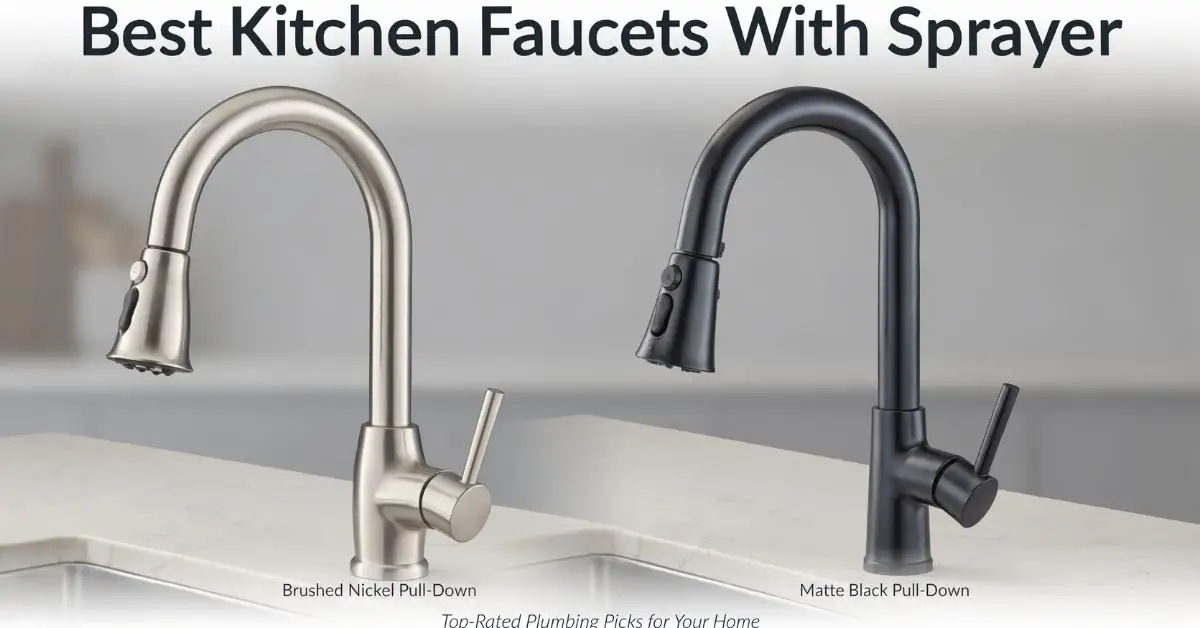
Pull-down faucets have a high-arc spout with a spray head that pulls straight down into the sink. This design is the most popular in US kitchens right now for good reason. The tall spout gives you room to fill large pots and tilted baking dishes. The spray head pulls down and retracts smoothly when you are done.
Pull-down faucets work best in kitchens where there is clearance above the sink for the tall spout, meaning no low cabinets directly overhead. They are ideal for deep sinks and for anyone who frequently washes large cookware.
Pull-Out Faucets
Pull-out faucets have a lower-profile spout with a spray head that pulls out toward you horizontally rather than straight down. This design works better in kitchens with low overhead clearance or windows directly above the sink where a tall pull-down spout would be impractical.
The trade-off is that pull-out faucets typically have a shorter hose reach than pull-down models, and the spray head is harder to direct precisely into corners of the sink. For kitchens without clearance issues, most people find pull-down more practical.
Side Sprayer
A side sprayer is a separate spray nozzle mounted next to the main faucet body in a dedicated hole in the sink deck. It operates independently of the main faucet, which means you can use the sprayer while the main tap is running or adjust them independently.
Side sprayers are common in older kitchens and work well in sinks with extra predrilled holes. They are generally less convenient than integrated sprayers because they require a second hand to operate, and the hose can tangle beneath the sink over time. Most new kitchen faucet installations favor integrated pull-down or pull-out designs.
Key Features That Actually Matter
Once you have identified which sprayer type fits your kitchen, these are the features worth evaluating before making a final decision.
Spray Modes
Most quality kitchen faucets with sprayers offer at least two spray modes: a standard stream for filling and a wide spray for rinsing. Better models add a pause function that temporarily stops water flow without turning off the faucet, a third boost or jet mode for removing stuck-on food, and sometimes a laminar flow mode for precise filling.
The pause function is more useful than it sounds. Being able to stop water mid-task without losing your temperature setting saves water and reduces mess when you are moving dishes around the sink.
Hose Reach and Flexibility
Hose reach determines how far you can extend the spray head to reach every corner of the sink, rinse items on the counter nearby, or fill a container on the counter. Standard reach runs from about 20 to 24 inches. Better models offer up to 28 or 30 inches.
Hose flexibility matters alongside reach. A stiff hose with good reach is harder to use than a flexible hose with slightly less reach. Look for braided nylon or stainless steel braided hoses over plain rubber or plastic ones, which degrade faster and kink more easily.
Spray Head Docking
A spray head that does not dock reliably is one of the most common and frustrating faucet complaints. The magnetic docking systems used by Delta, Moen, and Kohler consistently outperform friction-based or spring-loaded docking. Magnetic docking snaps the spray head into place precisely every time with minimal effort.
If you are testing a faucet in a showroom, test the docking specifically. A head that requires two hands or noticeable effort to dock will become increasingly annoying with daily use.
Valve Type
The valve is the internal mechanism that controls water flow and temperature. Ceramic disc valves are the most reliable choice for kitchen faucets. They are hard, smooth, and resistant to the mineral buildup that shortens the life of rubber washer-based valves. Most quality faucets in the $150 and above range include ceramic disc valves as standard.
Avoid faucets that do not specify the valve type in their product description. A quality manufacturer is transparent about this component because it is a genuine differentiator.
Flow Rate
Kitchen faucets in the US are regulated to a maximum of 2.2 gallons per minute (GPM) by federal standards, with many states restricting flow further to 1.8 GPM or lower. WaterSense certified faucets use a maximum of 1.5 GPM without sacrificing functional performance for most kitchen tasks.
For most kitchens, 1.8 GPM provides excellent pressure and coverage while reducing water usage compared to older high-flow faucets. The practical difference between 1.8 and 2.2 GPM is minimal for everyday tasks, and the savings on water bills add up meaningfully over years of daily use.
Finish Durability
Kitchen faucets face grease, food acids, cleaning products, and hard water every day. Finish durability is not cosmetic vanity. A finish that degrades quickly looks bad and, in some cases, affects the underlying metal.
Brushed nickel and matte black are the most practical finishes for kitchens because they hide water spots and minor scratches better than polished chrome. Many manufacturers apply spot-resistant coatings over these finishes that further reduce daily maintenance. Delta’s SpotShield and Moen’s Spot Resist coatings are well-regarded examples that deliver measurable improvement over uncoated finishes.
Comparing Sprayer Types for Different Kitchen Setups
| Kitchen Setup | Best Sprayer Type | Reason |
|---|---|---|
| Deep sink, high clearance above | Pull-down | A tall arc maximizes pot-filling and rinsing reach |
| Low overhead clearance or window above sink | Pull-out | Lower profile fits without clearance issues |
| Sink with extra pre-drilled holes | Side sprayer | Makes use of existing installation points |
| Small or shallow sink | Pull-out | A lower arc fits better in compact spaces |
| Double-basin sink | Pull-down | Greater reach covers both basins effectively |
| High-traffic family kitchen | Pull-down with magnetic dock | Most durable and convenient for heavy daily use |
What to Expect at Different Price Points
Kitchen faucets with sprayers span a wide price range. Here is what different budgets realistically deliver.
Under $100
Faucets in this range are typically made with more plastic internal components, rubber washer valves rather than ceramic discs, and finishes that may fade or wear within a few years of heavy use. They can work fine for light use situations but are not the best choice for a primary kitchen faucet used dozens of times daily.
$100 to $200
This is where quality starts to become consistent. Most faucets in this range include ceramic disc valves, solid brass bodies, and decent finish durability. Pull-down options from Delta, Moen, and Kohler at this price point perform reliably for most households. This range represents strong value for homeowners who want dependable daily performance without overspending.
$200 to $400
At this level, you gain better spray mode variety, stronger magnetic docking, improved hose systems, and more refined finish options. Spot-resistant coatings are standard. Build quality is noticeably higher, and most faucets in this range carry limited lifetime warranties that mean something because the manufacturers back them.
Above $400
Premium faucets add touchless activation, voice control compatibility, filtered water integration, and professional-grade build quality. These features make sense for homeowners doing a full kitchen renovation and wanting features that will still feel current in ten years. For most buyers, the $200 to $400 range delivers everything needed without the premium price.
A homeowner in Atlanta, Georgia, replacing a builder-grade faucet during a kitchen refresh might spend $220 on a Delta pull-down with magnetic docking and spot-resistant finish. That choice delivers a meaningful daily improvement over the original faucet and is supported by a strong warranty without approaching premium price territory.
Installation and Compatibility Basics
Even the best kitchen faucet with sprayer creates problems if it does not fit your sink. Here is what to confirm before purchasing.
Sinkholes
Most kitchen sinks have one, three, or four pre-drilled holes. A single-hole faucet with an integrated sprayer requires only one hole. A faucet with a separate side sprayer requires a second hole. Knowing your sink’s hole configuration before buying prevents returns and re-plumbing.
Deck plate option
Many quality kitchen faucets include an optional deck plate that covers multiple holes even when the faucet only uses one. This allows a single-hole faucet to be installed in a three-hole sink without additional work or visible gaps.
Supply line connections
Most US kitchen faucets connect to standard 3/8-inch compression supply lines. Confirm your shut-off valves match before installation. If your home has older plumbing with non-standard valves, upgrading the valves at the same time as the faucet is practical and prevents compatibility issues later.
Clearance and spout reach
Measure the distance from your faucet hole to the back wall of the sink and to the center of the basin before buying a pull-down faucet. Some high-arc models require more clearance than compact kitchens have. Most product listings include spout height and reach specifications for this reason.
Conclusion
Choosing the right kitchen faucet with a sprayer comes down to matching the sprayer type to your kitchen layout, prioritizing the features that will improve your daily routine, and investing enough to get a ceramic disc valve and a durable finish that will hold up to years of daily use.
A pull-down with magnetic docking is the right choice for most kitchens. Spend $150 to $300 from an established brand with a meaningful warranty. Confirm your sinkhole configuration and clearance before ordering. Follow those steps and you will end up with a faucet that genuinely improves how your kitchen works every single day.
If this guide was helpful, take a look at our related articles on how to install a kitchen faucet yourself and the best kitchen faucet finishes for hard water. Both give you the practical next steps for completing your kitchen upgrade successfully.