

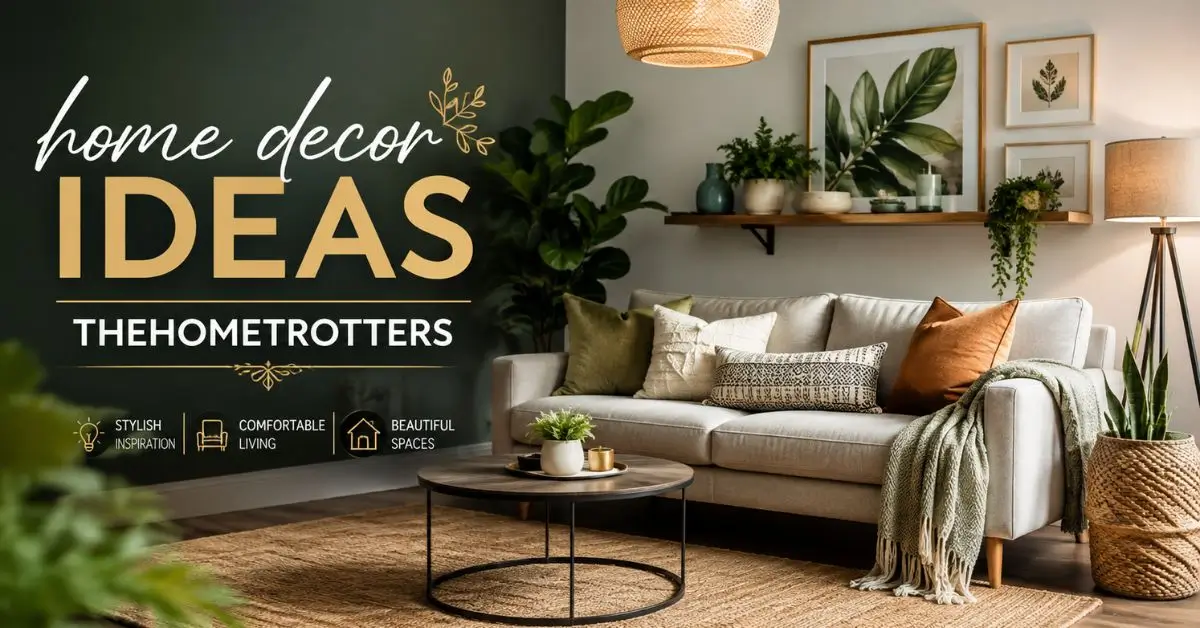
Home Decor Ideas from TheHomeTrotters
Decorating a home is one of those activities where most people know what they want the result to feel like but struggle to get from intention to execution. The room in your imagination is cohesive, warm, and personal. The room in your actual home has furniture you bought at different times, colors that were chosen without a plan, and accessories that individually seem fine but collectively do not quite work together.
This disconnect is not a taste problem or a budget problem. It is a knowledge gap. Without understanding a handful of core design principles, even well-intentioned decoration efforts produce spaces that feel half-finished or visually busy without a clear focal point. With those principles, almost anyone can create rooms that feel genuinely considered and personally meaningful.
The home decor ideas TheHomeTrotters promotes are built around exactly this kind of practical design knowledge. The platform connects creative inspiration with the kind of clear, executable guidance that helps homeowners actually transform their spaces rather than just admire other people’s homes online.
This guide brings the most valuable of those ideas together in one organized resource, covering every main room with specific ideas, honest budget context, and the design reasoning that helps you adapt each concept to your specific situation.
Home decor ideas from TheHomeTrotters refer to the practical interior styling guidance, room-specific decoration approaches, and design-informed inspiration published through TheHomeTrotters platform, helping homeowners make intentional decoration decisions that improve how their living spaces look, feel, and function. The ideas are built around accessible design principles that work across different budgets, property types, and personal styles without requiring professional help to execute successfully.
Quick Summary
TheHomeTrotters offers home decor ideas grounded in real design principles that anyone can execute. This guide covers the most effective room-by-room ideas, explains why each one works, and gives you the specific guidance to start improving your home this week.
What Makes a Home Decor Idea Actually Work
Before getting into room-specific ideas, understanding what separates decoration that works from decoration that does not helps you apply every idea in this guide more effectively.
The most common reason home decoration falls short of expectations is that homeowners focus on individual items rather than on how those items relate to each other and to the space they occupy. A beautiful sofa in the wrong size for the room looks worse than a less impressive sofa in exactly the right size. A striking piece of art on a poorly lit wall makes less impact than a simpler piece illuminated correctly.
TheHomeTrotters home decor ideas consistently return to three foundational principles that underpin every successful decoration decision.
Scale and proportion determine whether a space feels comfortable or off-balance. Furniture and décor that is correctly sized for the room creates harmony without any additional effort. Items that are too large make rooms feel cramped. Items that are too small look lost and make spaces feel incomplete regardless of their individual quality.
Light shapes everything. The same room with different lighting feels like two completely different spaces. Layered lighting from multiple sources at different heights and intensities creates atmosphere and depth that a single overhead fixture cannot achieve regardless of its wattage or style.
Restraint creates impact. The best-decorated rooms have fewer, better-chosen elements rather than more. Empty space in a well-decorated room is intentional, not accidental. It gives the eye places to rest and makes the elements that are present more visible and more meaningful.
Living Room Decor Ideas That Transform the Space
The living room receives the most decoration attention for good reason. It is the most social room, the most photographed room, and the one where design investment pays off most visibly every day.
Size Your Rug Correctly
The single most impactful living room change in the home decor ideas TheHomeTrotters consistently recommends is correctly sizing the area rug. An undersized rug is the most common visual error in US living rooms and one of the easiest to fix.
The correct size allows the front legs of all major seating pieces to rest on the rug. This anchors the furniture grouping visually, ties the seating area together, and signals to anyone entering the room that the arrangement is intentional rather than coincidental. In most American living rooms, eight by ten feet is the starting point, with nine by twelve being the right choice for larger furniture arrangements.
If purchasing a new rug is not immediately possible, simply pulling furniture closer together and creating a more intimate grouping around the existing rug improves the visual result at no cost.
Introduce a Gallery Wall as a Focal Point
A gallery wall done well creates a focal point that anchors a room and communicates something genuine about the people who live there. A gallery wall done poorly looks like a collection of unrelated frames hung randomly.
The difference is in planning. Lay all frames on the floor before committing anything to the wall. Arrange them within an area matching your target wall space until the composition feels balanced and intentional. Then transfer that arrangement to the wall, starting from the center and working outward. Use frames in two complementary finishes, black and natural wood or black and white, rather than mixing all available frame types, which creates visual noise rather than cohesion.
Add Plant Life
A single well-chosen plant in a well-chosen location does more for a living room’s warmth and character than most purchased decorative objects at any price point. Plants introduce organic texture, softness, and life that manufactured objects cannot replicate.
Large statement plants like a fiddle-leaf fig or a monstera make a strong visual impact in corners and beside furniture groupings. Trailing plants on shelves add movement and texture at eye level. Small plants on coffee and side tables add organic character to styled surfaces. A US homeowner in a rental apartment can transform their living room’s atmosphere with three plants and a quality basket planter for under $60.
Kitchen Decor Ideas for the Most-Used Room
Kitchens deserve decoration attention proportional to how much time people spend in them, which in most households is more than any other room.
Upgrade Hardware Before Anything Else
Cabinet hardware replacement is the kitchen decoration idea that consistently delivers the strongest visual return for the investment across every kitchen type. The contrast between dated hardware and updated hardware reads as a signal about the quality of the entire kitchen to every person who enters it.
Matte black, brushed nickel, and unlacquered brass are the hardware finishes that update most kitchens most reliably in 2025. The cost for a full kitchen is typically $50 to $200. The installation time is one afternoon. The visual result regularly surprises homeowners because the change is larger than the investment suggests.
Create a Styled Open Shelf
If your kitchen has open shelving, how it is used determines whether it looks intentional or chaotic. The home decor ideas TheHomeTrotters recommends for open kitchen shelving follow a simple but reliable structure.
Keep one-third of each shelf for items used regularly that also look attractive together, such as matching mugs or consistent glassware. Use one-third for plants, small objects, or one piece of meaningful art. Leave one-third intentionally lighter or empty to give the eye space to rest. This three-part approach produces shelving that looks curated without requiring professional staging.
Clear the Counter, Then Decorate
This is the kitchen idea that produces the most dramatic improvement for the least cost because it costs nothing. Clearing counters of everything except daily-use items and one intentional decorative element reveals how much visual capacity the kitchen actually has when it is not competing with accumulated clutter.
After the clear-out, add one curated group back: a plant in an attractive pot, a wooden cutting board leaned against the backsplash, a small tray with a few attractive kitchen objects. The contrast between the cleaned counter and the single intentional element makes both more impactful than either would be in a crowded context.
Bedroom Decor Ideas for Rest and Personal Expression
A bedroom should be the most personal room in the house and the one most effectively designed to support genuine rest. These ideas address both dimensions simultaneously.
Master the Art of the Layered Bed
A layered bed looks more inviting than a simple bedspread arrangement regardless of the individual quality of the components. The layering structure that professional stylists use consistently involves a duvet or comforter as the primary layer, a lighter throw blanket folded or draped at the foot of the bed for texture and tonal contrast, and a pillow arrangement that includes both sleeping pillows and a few decorative pillows that add visual depth without requiring removal every night.
The throw at the foot of the bed is the element most people skip and the one that most dramatically changes the room’s character. A quality throw costs $30 to $80 and transforms the bedroom’s visual warmth immediately.
Use Curtains to Change the Room’s Proportions
Curtains hung at window frame height make rooms feel shorter and smaller than they are. The same curtains hung from rods positioned near the ceiling and extending wider than the window frame on both sides make the room feel taller, the windows feel larger, and the overall space feel more architecturally generous.
This positioning change costs nothing if you are already planning to buy curtains and requires only moving two wall brackets, a fifteen-minute project. It is one of the most impactful yet most overlooked home decor ideas TheHomeTrotters consistently recommends for bedrooms.
Bathroom Decor Ideas That Polish the Smallest Rooms
Small rooms respond immediately to targeted improvement because every change is visible from every point in the space. Bathrooms reward decoration effort disproportionately to their size.
Replace the Standard Builder Mirror
The plain rectangular mirror that comes standard in most bathrooms is the decoration element most worth replacing because it defines the visual character of the space more than anything else. A framed mirror of the same or larger size costs $30 to $200 and transforms the bathroom’s design level from default to intentional.
Round mirrors work in contemporary spaces. Arched mirrors suit transitional aesthetics. Decorative frames make traditional spaces feel designed. The key is choosing a mirror that makes a decision rather than simply reflecting the room.
Invest in Consistent Towels
Two matching sets of quality towels in complementary tones make a bathroom look like a hotel room at minimal cost. The visual effect is immediate because towels are a large part of the color visible in most bathroom spaces, and inconsistency in that color disrupts the room’s visual cohesion regardless of how nice the other elements are.
Room-by-Room Decor Ideas Quick Reference
| Room | Top Idea | Cost Range | Time Needed | Skill Level |
|---|---|---|---|---|
| Living Room | Properly sized area rug | $80 to $400 | 30 minutes | None |
| Living Room | Gallery wall focal point | $50 to $200 | 2 to 3 hours | Beginner |
| Kitchen | Cabinet hardware replacement | $50 to $200 | 2 to 3 hours | Beginner |
| Kitchen | Counter clear and curate | $0 to $30 | 30 minutes | None |
| Bedroom | Layered bed with throw | $30 to $80 | 20 minutes | None |
| Bedroom | Ceiling-height curtain hang | $0 to $20 | 15 minutes | Beginner |
| Bathroom | Framed mirror replacement | $30 to $200 | 15 minutes | Beginner |
| Bathroom | Matched quality towel sets | $30 to $100 | 10 minutes | None |
Conclusion
Home decoration is most rewarding when it is approached with understanding rather than just enthusiasm. Knowing why certain ideas work in certain spaces allows you to adapt them to your specific situation rather than following them rigidly in contexts where they will not produce the same results.
The home decor ideas TheHomeTrotters promotes are built on this understanding. Every specific idea connects to a design principle that explains its logic, which means every idea in this guide can be adapted, scaled, or combined with others to suit your specific rooms, your specific style, and your specific budget.
Start with the room that matters most to your daily life. Identify the one element that is most clearly not working. Address that element well. Observe the result. Then decide what to do next from an informed position rather than from a list.
If you want to continue developing your decoration knowledge, check out our guide on how to develop your personal home decor style from scratch or our practical breakdown of the best low-cost home improvements that deliver professional-looking results. Both offer the same honest, design-grounded approach that makes TheHomeTrotters content genuinely useful.
Frequently Asked Questions
What home decor ideas from TheHomeTrotters work on a tight budget?
Decluttering, repositioning curtains, and styling existing items cost little or nothing. Towels, throws, and small accessories can also create affordable visual upgrades.
How do I choose colors for my home décor?
Choose one favorite color and build a three-color palette using the 60-30-10 rule. Always test paint samples in your actual room before committing.
What room should I decorate first?
Start with the room you use most, such as the kitchen, living room, or home office. Improve one space fully before moving to another.
How can I make a small home feel larger?
Use light colors, high curtains, large mirrors, visible-leg furniture, and less surface clutter to create a more spacious feel.
Can I mix different décor styles?
Yes. Combine styles using a consistent color palette, materials, or scale. A unifying element helps mixed styles look intentional rather than cluttered.