

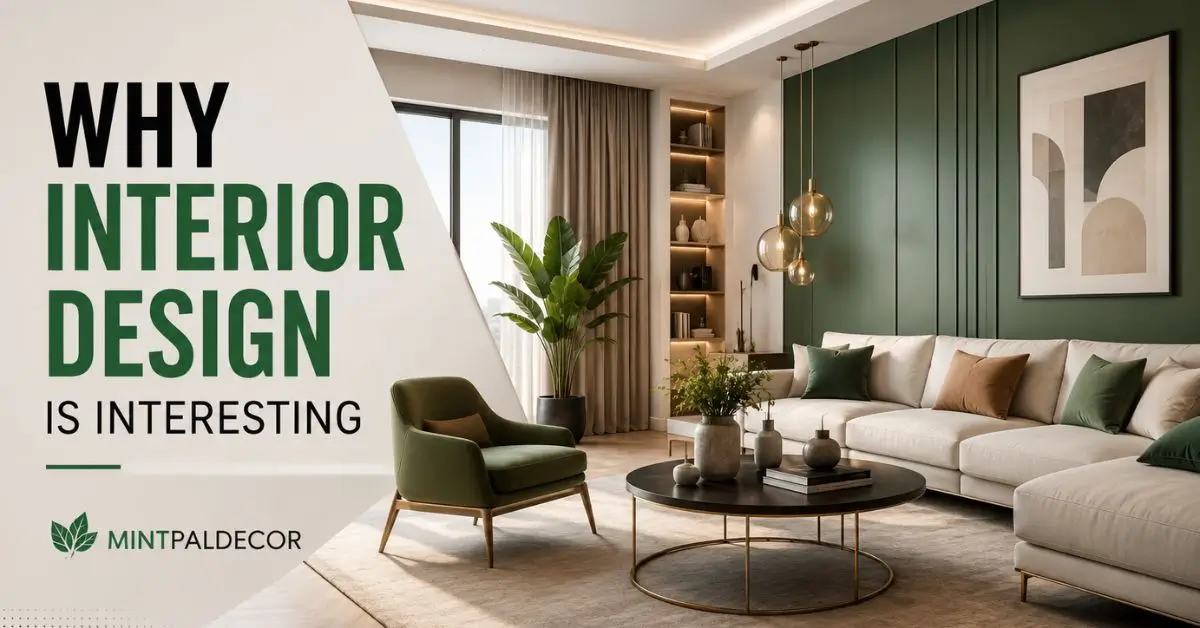
Why Interior Design Is Interesting MintPalDecor
Most people experience interior design before they ever study it. They walk into a room and immediately feel comfortable, or tense, or calm, or energized, without knowing exactly why. They see a space that looks effortlessly put together and cannot identify what specifically makes it work. They rearrange their own living room and feel the difference immediately without being able to explain what changed beyond the furniture positions.
That gap between feeling design and understanding it is exactly what makes interior design such a fascinating subject. It operates at the intersection of art and science, creativity and logic, personal expression and universal human psychology. It is both deeply subjective and governed by principles that work consistently across cultures, styles, and centuries.
Platforms like MintPalDecor have made this subject more accessible to everyday homeowners by translating professional design thinking into language and guidance that people without formal training can understand, apply, and genuinely enjoy. This guide explores why interior design is interesting at multiple levels, from the psychological to the practical, and why engaging with it changes how you experience every space you inhabit.
Why interior design is interesting MintPalDecor comes down to its unique position as a discipline that combines human psychology, spatial reasoning, visual art, cultural expression, and practical problem-solving in one integrated practice. MintPalDecor approaches this subject by making those intersecting dimensions accessible and applicable to real homeowners who want to understand not just what good design looks like but why it works and how to create it intentionally.
Quick Summary
Interior design is genuinely fascinating because it combines psychology, creativity, science, and personal expression in ways that directly affect how we feel and function every day. This guide explores what makes the subject so compelling and how MintPalDecor helps homeowners engage with those ideas practically.
Design Is the Only Art Form You Live Inside
Most art forms create something you observe from a distance. You stand in front of a painting. You sit in a concert hall. You watch a film. Interior design is unique because the art surrounds you completely. You do not observe a designed space from outside it. You live within it, move through it, work and rest and eat and think inside it every single day.
This immersive quality is what makes interior design different from every other creative discipline and what gives it such profound influence over human experience. The space you inhabit affects your mood, your productivity, your relationships, and your sense of identity in ways that are both measurable through research and immediately felt in daily life.
A poorly designed workspace creates friction that makes focused work harder without the person working there ever identifying the physical environment as the cause. A bedroom that does not support rest creates sleep quality problems that ripple through every other area of life. A home that reflects its owner’s genuine personality and values creates a sense of belonging and comfort that affects psychological wellbeing in documented, meaningful ways.
This is one of the central reasons why interior design is interesting to MintPalDecor and to the people who engage with it seriously. It is not decoration for its own sake. It is the shaping of the environment where human life actually happens.
The Psychology Behind Why Spaces Affect Us
One of the most genuinely fascinating dimensions of interior design is its deep connection to human psychology. Why do certain rooms make us feel calm while others make us feel anxious? Why do some spaces feel welcoming and others feel cold despite having similar physical dimensions? The answers lie in how the human brain processes visual information, spatial relationships, color, light, and proportion.
Color psychology is one of the most researched areas of this connection. Colors trigger consistent psychological responses across most human populations. Blue tones reliably reduce heart rate and create feelings of calm. Warm reds and oranges stimulate energy and appetite. Greens connect to nature and reduce stress. Yellow promotes optimism but in excess creates visual fatigue. Professional interior designers use this knowledge deliberately, which is why hospitals tend toward calm blues and greens while restaurants often incorporate warm, appetite-stimulating tones.
Spatial perception is equally fascinating. The human brain constantly processes the size, proportion, and scale of the spaces it inhabits and responds emotionally to what it perceives. Ceilings that are too low create unconscious feelings of constraint. Rooms that are too large without appropriate furniture scale create feelings of exposure and insecurity. The professional designer’s ability to manipulate perceived scale through color, furniture placement, mirrors, and lighting changes how a space feels without changing its physical dimensions at all.
Order and visual complexity affect cognitive load in measurable ways. Cluttered, visually complex environments increase cognitive fatigue and stress. Organized spaces with appropriate visual complexity, enough to be interesting but not so much as to be overwhelming, support both relaxation and focused thought. This is not an aesthetic preference but a neurological reality that good interior design accounts for.
Understanding these psychological mechanisms is part of what makes interior design so interesting as a subject. It reveals how profoundly physical environments shape mental experience in ways most people never consciously notice.
Design Is Problem-Solving in Three Dimensions
Another dimension that makes interior design genuinely compelling is its nature as a complex problem-solving exercise conducted in three-dimensional space. Every design project begins with a set of constraints: a physical space with fixed dimensions, existing architectural features that cannot be changed, a budget, a set of functional requirements, and a set of aesthetic preferences that may initially conflict with each other.
Working through those constraints toward a solution that is simultaneously beautiful, functional, comfortable, and personal requires a kind of thinking that engages both analytical and creative intelligence simultaneously. This combination is rare in most activities, which is part of why people who discover genuine interest in interior design often find it deeply satisfying in a way they struggle to fully articulate.
Consider a practical example. A homeowner in a Chicago apartment has a living room that is twelve feet wide and twenty feet long with a window at one end, a radiator along one wall, and a doorway positioned awkwardly close to the corner. Making that room feel comfortable, navigable, and visually balanced within a $2,000 furnishing budget while accommodating a large sofa for regular entertaining requires solving multiple overlapping problems simultaneously.
The satisfaction of finding a furniture arrangement that works with the awkward doorway, creates a clear traffic path, positions seating to take advantage of the window light, and makes the radiator an asset rather than an obstacle is the same satisfaction that comes from solving any complex puzzle where multiple constraints must be satisfied simultaneously.
MintPalDecor captures why interior design is interesting partly through this problem-solving lens, showing homeowners that the challenge of a difficult space is not a limitation but an invitation to creative thinking.
Design Tells Stories About the People Who Live There
Interior design is one of the most direct forms of personal expression available to people who do not consider themselves artists. The choices made in a living space, the colors, the objects, the furniture styles, the books on the shelves, the art on the walls, collectively create a portrait of the people who inhabit the space that is often more honest and revealing than anything they might say about themselves directly.
This storytelling dimension is what makes visiting a well-designed home so fascinating and what makes designing your own home such a meaningful personal project. Every object in a thoughtfully designed space was chosen for a reason. Every color combination reflects a preference. Every arrangement of furniture reveals something about how the occupants want to feel in that space and how they want guests to experience it.
The most interesting designed spaces are those where this personal story is clearly legible but not aggressively stated. A home that feels like a showroom tells no story because nothing in it belongs specifically to anyone. A home that is overwhelmed by personal objects tells too many stories at once and creates visual noise that prevents any single element from being truly seen. The designed space that is most interesting is one where personal character is present in the details without overwhelming the overall composition.
This is one of the ideas that runs through MintPalDecor’s approach to home improvement: helping homeowners find and express their genuine design identity rather than simply copying a style they have seen elsewhere.
The Relationship Between Design and Cultural History
Interior design is also fascinating as a window into cultural history. Every major design movement, from the ornate excess of Victorian interiors to the stripped-down functionalism of mid-century modernism to the warm naturalism of current Japandi aesthetics, reflects the values, concerns, and circumstances of the culture that produced it.
Victorian interiors with their dense layering of objects, heavy drapery, and dark wood reflected a culture of affluence, accumulation, and formality that valued visible wealth and social display. Mid-century modern design, born in the post-World War II period, reflected a culture optimistic about technology, eager for simplicity after years of conflict, and increasingly focused on comfort and family life rather than formal entertaining.
Current design trends toward natural materials, quiet colors, and reduced visual complexity reflect a culture increasingly aware of environmental impact, overwhelmed by digital stimulation, and seeking calm and grounding in domestic spaces. Understanding design history through this cultural lens reveals how spaces are never just aesthetic choices but expressions of how a society understands the good life at a particular moment in time.
This historical dimension is part of why interior design is interesting beyond its immediate practical application. It connects every design decision to a larger human story.
Design as a Learnable Skill That Improves With Practice
One of the most practically exciting things about interior design is that it is genuinely learnable. Unlike some artistic disciplines where natural talent plays a dominant role, interior design is built on principles that can be understood intellectually and developed through deliberate practice by anyone willing to engage with them seriously.
The core principles of balance, scale, proportion, color theory, light management, and spatial organization are learnable concepts rather than innate gifts. A person who understands these principles can apply them to any space and consistently produce results that feel more intentional and more successful than the results of someone decorating purely on instinct.
This learnable quality is precisely what platforms like MintPalDecor are built to support. By explaining the principles behind good design in accessible language and connecting them to real home improvement decisions, the platform helps homeowners develop genuine design literacy that improves every space-related decision they make going forward.
The experience of learning interior design principles and then noticing them everywhere, in restaurants, hotels, workplaces, and friends’ homes, changes how you experience built spaces permanently. You begin to see the decisions behind every room rather than just experiencing the result of those decisions. That shift in perception is one of the most genuinely interesting effects of engaging seriously with interior design as a subject.
What Makes Interior Design Interesting Across Different Dimensions
| Dimension | Why It Is Fascinating | Practical Application |
|---|---|---|
| Psychology | Spaces directly affect mood and cognition | Choose colors and layouts that support how you want to feel |
| Problem-Solving | Constraints require creative three-dimensional thinking | Approach difficult rooms as design puzzles with satisfying solutions |
| Personal Expression | Design tells your story without words | Choose objects and colors that genuinely reflect your identity |
| Cultural History | Design movements reflect cultural values and concerns | Understand why certain styles appeal to you at this moment |
| Learnable Skill | Principles can be studied and applied by anyone | Develop design literacy that improves every space decision you make |
| Sensory Experience | Design affects sight, touch, sound, and smell simultaneously | Layer materials and textures for a richer sensory environment |
Conclusion
Interior design is interesting because it is genuinely, multiply fascinating. It engages our psychology, challenges our spatial reasoning, expresses our identity, connects us to cultural history, and improves our daily quality of life simultaneously. It is a discipline where learning more consistently makes daily life better in immediate, tangible ways that few other subjects can claim.
The reason platforms like MintPalDecor invest in making this subject accessible is precisely because of that real-world impact. When homeowners understand why interior design works, not just what it looks like, they make better decisions about their spaces, live more comfortably within them, and develop a way of seeing the built environment that permanently enriches how they experience the world.
If you want to continue exploring this subject, check out our guide on how to develop your personal interior design style or our practical breakdown of the core design principles every homeowner should understand. Both offer the same engaging, accessible approach to interior design that makes the subject as useful as it is genuinely interesting.
Frequently Asked Questions
Why is interior design so interesting?
Interior design blends creativity, functionality, and personal expression to create spaces that improve everyday living.
Can beginners learn interior design?
Yes. Anyone can learn the basics of color, lighting, balance, and furniture placement through practice and guidance.
How does interior design affect wellbeing?
Well-designed spaces can reduce stress, improve focus, and create a more comfortable living environment.
What makes a room look interesting?
A focal point, layered textures, balanced colors, and thoughtful décor make a room feel stylish and inviting.
How does MintPalDecor help homeowners?
MintPalDecor offers simple, practical interior design tips that help homeowners create beautiful spaces without professional experience.