

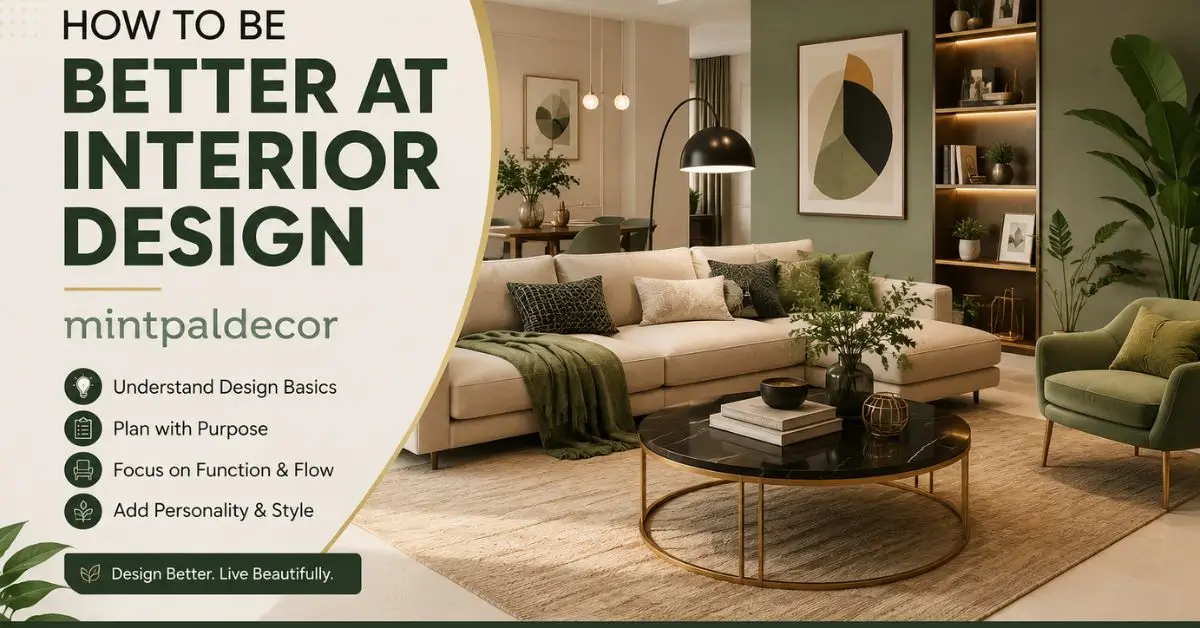
How to Be Better at Interior Design Mintpaldecor
Most people look at a beautifully designed room and think, “I could never do that.” But the truth is, interior design is a skill. Like any skill, you can learn it, practice it, and genuinely get better at it over time. You do not need a design degree or a huge budget to make your home look and feel amazing.
The problem is that most people do not know where to start. They buy things they love individually, but those items never seem to work together. The room feels off, but they cannot explain why.
Interior design is the process of planning and arranging the interior of a space to make it both functional and visually appealing. It involves balancing elements like color, light, furniture, texture, and proportion to create a room that feels intentional and comfortable.
Quick Summary
Getting better at interior design comes down to understanding a few core principles, training your eye over time, and making thoughtful decisions instead of impulse ones. This guide will walk you through exactly how to do that.
Start by Understanding the Basics of Design
Before you rearrange your living room or repaint a wall, spend time learning the foundational principles. These are the rules that professional designers use every single day.
The main principles include balance, contrast, rhythm, emphasis, and scale. You do not need to memorize definitions. You just need to understand how they feel in a real room.
For example, balance is why a large sofa on one side of the room needs something of visual weight on the other side. It could be a bookshelf, two accent chairs, or even a large piece of wall art. Without that balance, the room feels lopsided, even if you cannot immediately explain why.
Start by looking at rooms you love online and asking yourself what makes them work. Train your eye before you spend a single dollar.
Get Comfortable with Color Before You Commit
Color is one of the most powerful tools in interior design. It can make a small room feel larger, a dark room feel brighter, or a cold space feel warm and inviting.
But color is also where most beginners make mistakes. They see a bold color on a paint chip, love it, and paint an entire room without testing it first.
Here is what actually works: pick a color palette of three tones. One dominant color for your walls or large furniture, one secondary color for accent pieces, and one neutral to tie everything together. This is called the 60-30-10 rule, and it works for almost every room.
For example, imagine a living room where 60% of the space uses a warm white, 30% uses a soft sage green in the sofa and curtains, and the remaining 10% uses terracotta in throw pillows and a vase. That combination feels cohesive and intentional without being overdone.
Always test paint samples on your actual wall in different lighting before committing. Natural daylight and artificial light change colors dramatically.
Learn How to Use Light Properly
Lighting is the element that most homeowners overlook entirely. Yet it is one of the first things a trained designer thinks about when entering a space.
There are three types of lighting every room needs:
- Ambient lighting is the main source of light, usually from ceiling fixtures. It fills the room with general light.
- Task lighting is focused light for specific activities, like a reading lamp next to a chair or under-cabinet lights in a kitchen.
- Accent lighting highlights architectural features or decor, like a wall sconce near a piece of art or a small spotlight above a bookshelf.
When a room only has one overhead light source, it tends to feel flat and uninspiring. Adding layered lighting changes the entire mood of the space without changing a single piece of furniture.
Dimmer switches are one of the best low-cost upgrades you can make to almost any room.
Understand Scale and Proportion
This is one of the most common mistakes beginners make: buying furniture that is the wrong size for the room.
A huge sectional sofa in a small apartment makes the room feel cramped and suffocating. A tiny rug under a large dining table looks like an afterthought. These scale issues immediately make a space feel off, even to someone who cannot explain why.
Before buying any furniture, measure your room and draw a rough floor plan. You can use free tools like Roomstyler or simply sketch it on paper. Then measure the furniture dimensions before purchasing.
A general rule for rugs: in a living room, the front legs of all major seating pieces should sit on the rug. This grounds the furniture and ties the seating area together visually.
Build a Design Eye Through Consistent Inspiration
One of the fastest ways to get better at interior design is to study rooms that work. Not just scrolling Instagram passively, but actually analyzing what you see.
When you come across a room you love, ask yourself:
- What colors are being used, and how many?
- How is the furniture arranged?
- Where is the light coming from?
- What textures and materials are mixed together?
- What is the focal point of the room?
Over time, you will start to notice patterns. You will develop an instinct for what works and why. This is how professionals train their eye, and it is something any homeowner can do.
Creating a mood board, either digitally on Pinterest or physically by cutting images from magazines, helps you see whether your ideas actually work together before you spend money.
Mix Textures, Not Just Colors
A room can use a perfectly chosen color palette and still feel flat. The reason is usually a lack of texture.
Texture adds depth and warmth to a space. It is the difference between a room that looks like a showroom and one that feels like a real home.
Think about mixing materials deliberately: a linen sofa paired with a wool throw, a wooden coffee table on a jute rug, metal lamp bases next to ceramic vases. These combinations create visual interest without adding clutter or complexity.
The goal is contrast. Soft with rough. Matte with shiny. Natural with manufactured. When textures are layered thoughtfully, a room feels rich and considered even with minimal decor.
Declutter Before You Decorate
This sounds simple, but it is one of the most important steps in improving any space. Too many objects compete for attention and make even well-designed rooms feel chaotic.
Before you buy anything new, remove what is not working. Pull everything off a shelf or out of a room and only bring back what is intentional and meaningful.
Designers often talk about negative space, which is the empty area in a room. Empty space is not wasted space. It gives the eye a place to rest and makes the things you do display stand out more.
A single well-chosen vase on a console table makes more impact than seven random objects crowded together.
Learn from Real Spaces Around You
One practical habit that helps you get better at interior design is paying attention to spaces in real life. Visit model homes, walk through furniture showrooms, or spend time in well-designed hotels or restaurants.
Notice how the furniture is arranged. Look at what is on the walls and why it works. Observe how lighting changes the mood. These real-world observations stick with you far better than theory alone.
If you live in the US, cities like Chicago, New York, and Los Angeles have excellent design districts and showrooms open to the public. Even walking through a well-designed Restoration Hardware store can teach you about scale, material mixing, and how professionals stage a space.
Make Small Changes Before Big Investments
One of the smartest approaches to improving your interior design skills is to start small. You do not need to renovate your home to make a meaningful difference.
Swapping outdated hardware on kitchen cabinets, adding a large mirror to a small room, replacing a tired area rug, or updating curtains to floor-length panels can transform a space for a few hundred dollars.
These small wins also build your confidence and your eye. The more intentional choices you make, the better you get at understanding what works in your specific home.
Helpful Comparison: Common Beginner Mistakes vs. What to Do Instead
| Beginner Mistake | Better Approach |
|---|---|
| Buying furniture before measuring | Always measure the room and furniture first |
| Using only one light source | Layer ambient, task, and accent lighting |
| Choosing paint color from the chip alone | Test samples on the wall in different lighting |
| Mixing too many colors randomly | Use the 60-30-10 color rule |
| Buying a rug that is too small | Size up; front legs of furniture should sit on the rug |
| Overcrowding shelves and surfaces | Edit down and leave intentional negative space |
Conclusion
Getting better at interior design is not about having expensive taste or a natural gift. It is about learning the right principles, training your eye, and making deliberate choices instead of impulse ones.
Start with what you have. Study rooms you love. Understand why things work. And make small, intentional improvements over time. The results will surprise you.
If you want to go deeper, explore guides on choosing the right furniture layout for your space or understanding how color psychology affects mood in your home. Both topics can take your design skills to the next level.
Frequently Asked Questions
Can I learn interior design without formal training?
Yes. You can build strong design skills through books, online resources, practice, and studying well-designed spaces.
What is the 60-30-10 rule?
It’s a color guideline: 60% dominant color, 30% secondary color, and 10% accent color for a balanced look.
How can I make a small room look bigger?
Use light colors, hang curtains high, add mirrors, choose furniture with exposed legs, and keep clutter minimal.
What should I focus on first when redesigning a room?
Start with the room’s focal point, such as the sofa or bed, and build the layout around it.
How long does it take to get good at interior design?
With regular practice, most people see noticeable improvement within 6–12 months.